

What to do now to protect your home, your claim, and your right to be paid in full
Florida law gives you one year from the date of loss to report a hurricane insurance claim and 18 months to file a supplemental claim for damage you find later. For Hurricane Isaias, that means October 9, 2027 and April 9, 2028. Your insurer generally has 60 days to pay or deny your claim once you report it, so report it as soon as you safely can.
On the evening of October 9, 2026, Hurricane Isaias made landfall near Destin as a Category 2 storm with maximum sustained winds of 105 mph. Across the Panhandle, families are now dealing with torn-off roofs, flooded homes, and lost belongings, and many are about to face a second challenge: the insurance claim.
The steps you take in the next few weeks can decide whether your claim is paid fairly, paid partially, or not paid at all. This guide walks you through them in order.
Florida hurricane insurance claim deadlines for Hurricane Isaias
Florida law sets strict time limits for reporting hurricane damage. Miss them, and your claim can be barred for good, no matter how serious the damage.
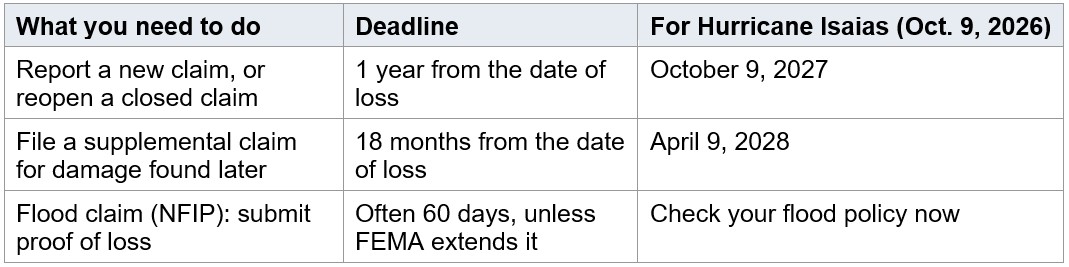
Deadlines are based on section 627.70132, Florida Statutes. Your policy may set additional requirements, so read it closely or have it reviewed.
Step 1: Put safety first
- Wait for the all-clear. Do not go back into your home until local officials say it is safe. Watch for structural damage, downed power lines, gas leaks, and standing water, which may be electrified or contaminated.
- Stop the damage from getting worse. Most Florida policies require you to make reasonable emergency repairs, such as tarping the roof, boarding broken windows, and removing standing water. Photograph the damage before you make these repairs and keep every receipt. These costs are usually part of your claim.
Step 2: Document everything
Good documentation is the strongest evidence you will have. When in doubt, take more.
- Photos and video. Before you clean up, photograph and film every room, inside and out: damaged walls, ceilings, floors, appliances, and personal belongings. Capture the street and neighborhood too, which helps show the force of the storm.
- Look for hidden damage. Roof, attic, and water damage is often not visible right away. Please do not climb onto your roof yourself. Have a licensed Florida roofer or contractor inspect it and give you a written report.
- Make an inventory. List every damaged or destroyed item with a description, approximate purchase date, and cost if you know it. Do not throw anything away until it has been photographed and, ideally, seen by the adjuster.
- Keep a claim log. Write down every contact with your insurance company: the date, time, the representative’s name, and what was said. Follow up important phone calls by email so you have a written record.
Step 3: Report your hurricane insurance claim promptly
- Notify your insurer right away. Call your agent or insurance company as soon as you can and get a claim number. The one-year deadline is the latest you can report, not the target. Waiting makes it harder to prove what the storm caused.
- Know your hurricane deductible. Florida policies carry a separate hurricane deductible, usually 2% to 10% of your home’s insured value (listed on your declarations page). On a $400,000 home, a 2% deductible is $8,000. It works very differently from your regular dollar-amount deductible.
- Wind and flood are separate claims. Standard homeowners policies cover wind damage but exclude rising water and storm surge. If water came in from outside, you will need to file a separate claim under a flood policy, which has its own rules and much shorter deadlines.
Step 4: Work through the hurricane insurance claim process
- Meet the insurance adjuster. Your insurer will send an adjuster to inspect the damage at no cost to you. Be present, walk them through every problem area, and give them copies of your photos and inventory. Be courteous and cooperative, but remember that the company’s adjuster works for the insurance company, not for you.
- Know the insurer’s timelines. Florida law generally requires your insurer to acknowledge your claim within 7 days and to pay or deny it within 60 days after you report it, unless factors beyond its control prevent that. Ask for every decision in writing.
- Watch out for storm chasers. After every major storm, unlicensed contractors and “claim helpers” go door to door. Before you hire anyone, verify their Florida license through the Department of Business and Professional Regulation (myfloridalicense.com).
- Do not sign away your claim. For policies issued on or after January 1, 2023, Florida law no longer allows homeowners to sign an Assignment of Benefits (AOB) over to a contractor. Anyone asking you to sign one, or any document that gives them control of your claim or your insurance check, is a red flag. Talk to a lawyer before you sign.
Step 5: If your claim is denied or underpaid
Your insurer’s first decision is not necessarily the final word. That decision may say your damage falls below the deductible, deny the claim based on a policy provision, or offer a payment that does not cover the true cost of repairs.
- You can usually accept a payment and keep going. In most cases, cashing an initial check does not end your claim, as long as you have not signed a release. Read anything you are asked to sign carefully, and do not sign a release before having it reviewed.
- Get a professional review quickly. Underpaid and denied claims are common after major hurricanes. A property insurance attorney can review your policy, the adjuster’s estimate, and your documentation, and tell you whether you are owed more. Because Florida requires specific notices before a lawsuit can be filed, it pays to start early.
Hurricane insurance claim FAQs
How long do I have to file a hurricane insurance claim in Florida?
You have one year from the date of loss to report a new claim or reopen a closed one, and 18 months to file a supplemental claim for damage you find later. For Hurricane Isaias, those dates are October 9, 2027, and April 9, 2028. Report it sooner, because waiting makes it harder to prove what the storm caused.
How long does an insurance company have to pay a hurricane claim in Florida?
Florida law generally requires your insurer to acknowledge your claim within 7 days and to pay or deny it within 60 days after you report it, unless factors beyond its control prevent that. Ask for every decision in writing.
Does homeowners insurance cover flood damage from a hurricane?
Usually not. Standard homeowners policies cover wind damage but exclude rising water and storm surge. If water came in from outside, you will need to file a separate claim under a flood policy, which has its own rules and much shorter deadlines.
Does cashing my first insurance check end my claim?
In most cases, no. Cashing an initial check does not end your claim, as long as you have not signed a release. Have any release reviewed before you sign it.
We are here to help
If Hurricane Isaias damaged your home or business and you have questions about your claim, or if your insurer has delayed, denied, or underpaid it, contact Vernon Litigation Group for a free, no-obligation consultation. Call (239) 319-4434 or visit our website.
We will review your policy and your claim and explain your options in plain language, so you can focus on getting your home and your life back to normal.
This article provides general information only and is not legal advice. Reading it does not create an attorney-client relationship. Every claim is different; for advice about your situation, speak with a licensed Florida attorney.